
METHODOLOGY & EVIDENCE
AIHT Rating
methodology
A score is a starting point.
The evidence gives it meaning.
Understand what our reviews show, what a reproducible comparison needs, and how to judge a rewrite against your own work.
Read the evidence status Try the evaluation checklist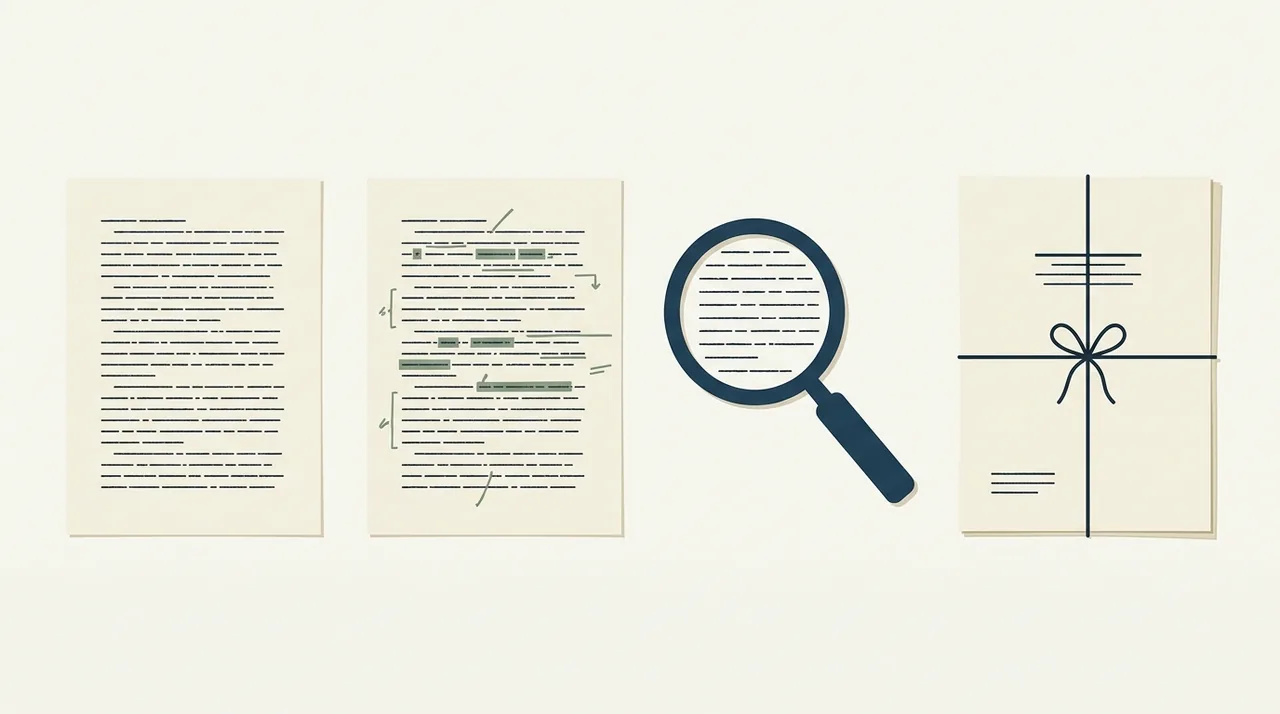
Conceptual illustration of the process, not a record of completed tests.
AIHT RATING / EDITION 2026.10
The record behind the rating
One published rating per tool, used consistently across the leaderboard, reviews, comparisons and embeddable badges.
Current edition: editorial baseline
Published 8 October 2026. The edition preserves the existing comparison scores and component figures. It consolidates the site's rating presentation without claiming a new round of testing.
How rank is determined
Tools are ordered by AIHT Rating from highest to lowest. Equal scores share a rank. Unrated tools receive no numerical position.
Rank = 1 + the number of tools with a higher AIHT Rating.
Overall score and component figures. The original weighting formula is not published. The overall rating is an editorial value in this edition, rather than a result readers can recalculate from the displayed components. Decimals preserve the source precision; they do not establish statistical significance.
| Field | Published definition |
|---|---|
| Record identifier | 2026-10 / editorial-baseline-v1 |
| Scale | AIHT Rating out of 100. Separate from detector percentages and historical five-point displays. |
| Included records | 16 rated tools, with meaning, readability, aggregate detector figures and recorded penalties. |
| Detector labels in the source records | GPTZero, Proofademic, ZeroGPT, Copyleaks and Originality.ai. Listing these labels does not establish current versions or test conditions. |
| Missing reproducibility inputs | Source samples, rewritten outputs, run logs, sample counts, settings, detector versions and the original formula. |
| Citations | Tool name, AIHT Rating, edition and a link to the published record. Choose an edition-specific badge. |
Publication and correction policy
A rating update requires a dated record and an explanation of what changed. A future test-derived edition must publish its evaluation protocol, inputs, outputs, scoring rules and run evidence. Preserve earlier editions so readers can distinguish an actual score change from a design or wording update.
Corrections to labels or presentation do not imply that tools were retested. This methodology update on 10 October 2026 clarifies the October 2026 edition; it does not alter its scores.
01 / THE CURRENT RECORD
What the evidence supports
Editorial descriptions and stored scores help you find the site’s published view of a tool. They do not, on their own, show how a result was produced.
| Material | Availability | What this means for you |
|---|---|---|
| Product reviews & comparisons | Published | Use the editorial content to build a shortlist, then check current product details. |
| AIHT Ratings & detector figures | Summary only | Read each component in context. The overall rating and detector percentages are different measures. |
| Original & rewritten samples | Not published | A percentage alone cannot establish the quality of the resulting text. |
| Run logs, versions & scoring formula | Not published | An exact result cannot currently be reproduced from these pages. |
Site ratings are not verified customer-review averages. An article’s update date is not evidence that a new product test occurred.
02 / THE EVALUATION STANDARD
Keep the entire trail
A reproducible comparison connects the input to the final result. This is the standard to work toward, not a claim that all existing scorecards meet it.
- 01INPUT
Keep the source
Save identical passages, their length, writing type and intended audience.
Record: the original text - 02REWRITE
Record the run
Note the tool, plan, mode, date, settings and every output, including failures.
Record: all attempts - 03REVIEW
Check the meaning
Compare facts, quotations, terminology, tone and the editing still required.
Record: corrections needed - 04REPORT
Show the evidence
Publish samples, detector results, denominators and the scoring rule together.
Record: the calculation
Same input. Documented conditions.
Record any limits that prevent a like-for-like run. Keep all attempts, repeat across relevant writing types and report variation, rather than selecting only the strongest output.
Different questions. Separate measures.
Writing quality, meaning, cost and detector response answer different questions. A tool can improve one while making another worse. A composite score needs an explicit formula and visible weights.
03 / THE READER’S GUIDE
Know what the number measures
- Overall score
- A composite number needs its component metrics and weights. It is not a universal quality scale.
- Detector result
- A detector’s probability estimate is different from the share of samples that passed a defined threshold.
- Bypass rate
- A reproducible rate needs a threshold, a numerator, a denominator and a detector version or run date.
- Meaning & readability
- Check names, numbers, facts, qualifiers and citations. Smooth sentences can still be inaccurate.
The AIHT Rating standardizes the overall score across pages. Supporting component figures remain separate measures; decimal precision is not evidence of statistical certainty.
04 / KNOW THE LIMITS
A detector score
is not proof of authorship.
It does not establish originality, permission to use AI, or compliance with a school’s or employer’s policy. Results can change with the passage, length, writing style and detector.
One favorable result does not guarantee the same outcome on another text or service.
Read the Grammarly detector limitationsThe guide links to the provider’s caveats. Grammarly is not part of the site’s five-detector summary dataset.
05 / BEFORE YOU SUBSCRIBE
Test the work
you actually do
Use a short, representative passage and judge the rewrite against your requirements.
Open the buying checklist- Choose a representative passage
Remove private or confidential information before sending it to a third-party service.
- Define a successful rewrite
List the facts, terminology, tone, citations and length it must preserve.
- Keep the original and every output
Compare the texts side by side. An overall score cannot replace reading them.
- Count the editing still needed
Include corrections and revision time in your assessment of value.
- Check the plan and repeat
Confirm current limits and cancellation terms. Try a second, different passage before committing.
06 / COMMERCIAL CONTEXT
How to read our recommendations
Some outbound links may be affiliate links. Read our affiliate disclosure before using them. Commercial placement and published rankings are not substitutes for reproducible test evidence.
Evidence limitations were made explicit on October 6, 2026. The October 10 update documents the AIHT Rating edition and publication rules. It does not represent a new benchmark run or change the scores stored elsewhere on the site.
QUESTIONS & ANSWERS
About the evidence
Can I reproduce the published benchmark scores?
Not from the material currently published here. Raw samples, detector-run logs and a complete calculation rule are needed to reproduce an exact result.
Why is the AIHT Rating different from a detector percentage?
The AIHT Rating is the overall editorial score out of 100. A detector percentage describes a separate recorded metric. The same edition uses one AIHT Rating per tool across its leaderboard, review and comparison pages.
Does a high score guarantee that a detector will accept my text?
No. A stored result cannot guarantee an outcome for another passage, detector or version. It also cannot establish authorship or compliance with a policy.
Was a new benchmark run for this methodology update?
No. The October 10, 2026 update explains the rating edition, current evidence status and evaluation criteria. It does not represent new tool or detector tests.
PUT IT INTO PRACTICE